 Paraphrasing
Paraphrasing involves rephrasing original text in different words while preserving its core meaning. Searches for "how does paraphrasing help readers" often stem from educators, students, and writers seeking ways to enhance content accessibility. This technique plays a key role in communication by simplifying dense information, making it relevant across academic, professional, and everyday contexts where clear understanding is essential.
What Is Paraphrasing?
Paraphrasing is the process of expressing ideas from a source in one's own words, maintaining the original intent without direct quotation. It requires deep comprehension of the source material to restructure sentences, replace vocabulary, and adjust syntax while avoiding alteration of facts or implications.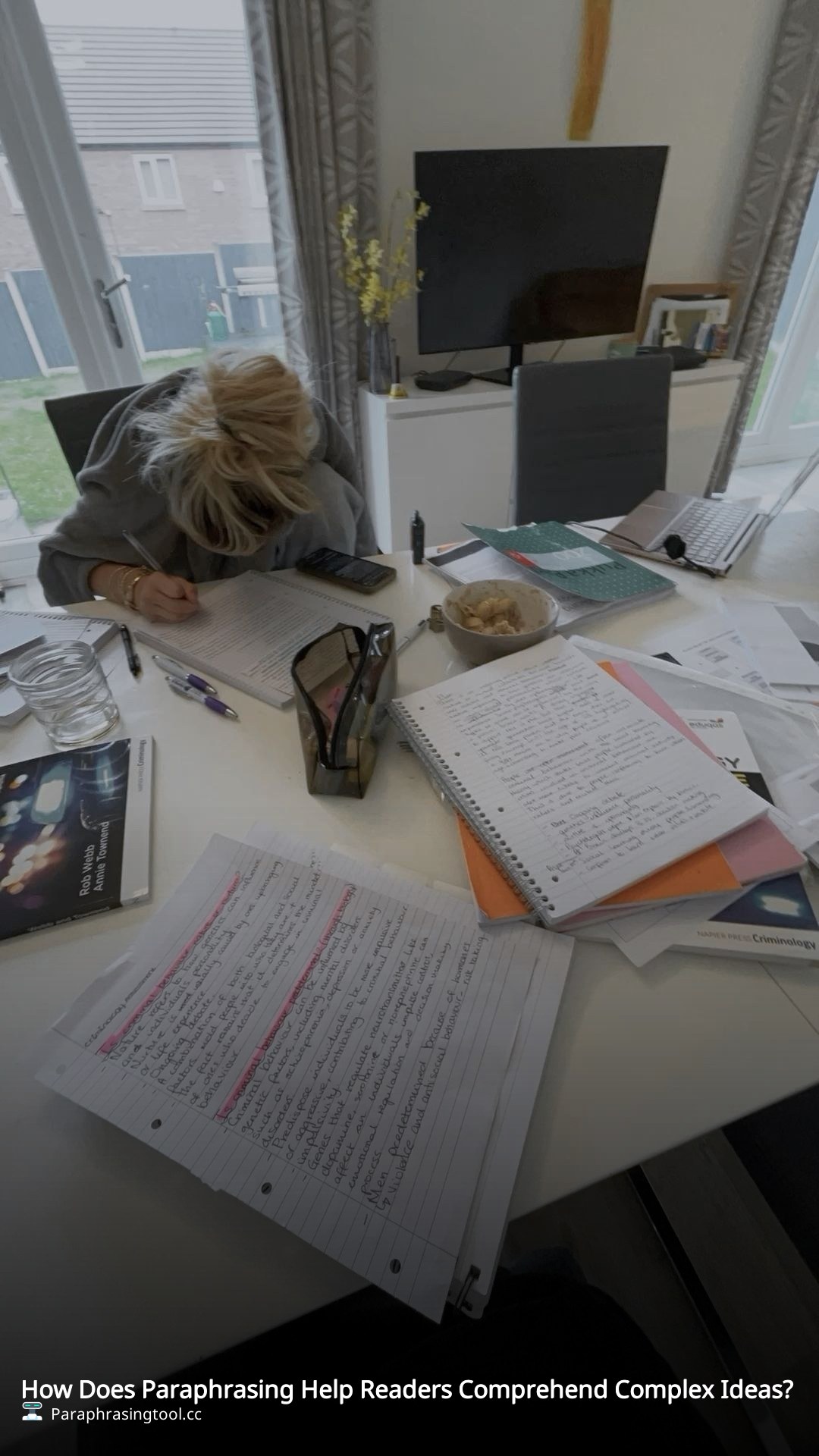
For instance, the sentence "Climate change accelerates biodiversity loss through habitat disruption" could be paraphrased as "Global warming speeds up the decline of species diversity by altering living environments." This method ensures fidelity to the source while adapting form.
How Does Paraphrasing Help Readers?
Paraphrasing aids readers by breaking down complex or jargon-heavy text into simpler, more familiar language, thereby improving comprehension and retention. It addresses barriers like unfamiliar terminology or convoluted sentence structures that can hinder understanding.
Readers benefit from enhanced clarity, as rephrased content aligns better with their knowledge level. Studies in reading psychology indicate that simplified phrasing reduces cognitive load, allowing quicker processing of information. In educational settings, teachers use paraphrasing to explain concepts, helping students grasp abstract ideas more effectively.
Additionally, it promotes inclusivity by making content accessible to diverse audiences, such as non-native speakers or those with varying literacy levels. For example, technical reports paraphrased for general audiences retain key insights without overwhelming details.
How Does Paraphrasing Work?
Paraphrasing operates through a systematic approach: first, fully understand the source; second, identify main ideas; third, rewrite using synonyms and varied structures; and finally, verify accuracy against the original.
This process involves techniques like changing active to passive voice, altering word order, or substituting phrases. Tools such as thesauruses assist, but manual effort ensures nuance preservation. Effective paraphrasing transforms "The economy experienced a downturn due to inflationary pressures" into "Rising prices led to an economic slowdown."
The mechanism relies on semantic equivalence, where meaning transfer occurs without loss, directly supporting reader-friendly adaptations.
Why Is Paraphrasing Important for Readers?
Paraphrasing holds importance for readers because it facilitates deeper engagement with material that might otherwise be inaccessible. By customizing language to audience needs, it boosts information absorption and critical thinking.
In cognitive terms, it leverages principles like the "readability formula," where shorter sentences and common words improve focus. Research from linguistics shows paraphrased texts increase recall rates by up to 20% in comprehension tests. For readers in fast-paced environments, such as online learners, this efficiency translates to better outcomes.
Its relevance extends to professional fields, where paraphrasing legal or scientific documents ensures stakeholders fully understand implications without misinterpretation.
What Are the Key Differences Between Paraphrasing and Related Techniques?
Paraphrasing differs from quoting, which uses exact words with attribution; summarizing, which condenses content; and plagiarism, which copies without credit. Paraphrasing rewords fully while covering similar length and detail to the original.
Unlike summarizing, which shortens by omitting details—"The report highlights economic risks" from a multi-page analysis—paraphrasing maintains scope. Quoting preserves phrasing for precision, e.g., ""Inflation erodes purchasing power,"" whereas paraphrasing states "Rising costs diminish buying ability."
These distinctions clarify when to apply each: paraphrasing for explanation, quoting for authority, summarizing for brevity.
Need to paraphrase text from this article?Try our free AI paraphrasing tool — 8 modes, no sign-up.
✨ Paraphrase NowWhen Should Paraphrasing Be Used to Help Readers?
Paraphrasing should be employed when original text poses readability challenges, such as in academic papers, technical manuals, or public communications targeting broad audiences.
Ideal scenarios include lesson plans, where instructors rephrase textbooks; blog posts simplifying research; or presentations adapting data for non-experts. Avoid it when legal precision demands exact wording, like contracts.
Timing also matters: use during content revision or real-time explanation to bridge knowledge gaps dynamically.
Common Misunderstandings About Paraphrasing
A frequent misconception is that paraphrasing merely swaps synonyms, which risks changing meaning if context is ignored. True paraphrasing demands holistic rewriting.
Another error views it as unnecessary for clear sources, overlooking how audience variability necessitates adaptation. Some confuse it with plagiarism, but proper attribution resolves this—paraphrasing still requires source citation.
Clarifying these points ensures effective application, preventing diluted messages or ethical issues.
Advantages and Limitations of Paraphrasing for Readers
Advantages include heightened accessibility, improved retention, and versatility across mediums. Readers gain from tailored content that respects their processing capacity, fostering equitable knowledge access.
Limitations arise if poorly executed, potentially introducing bias or inaccuracies. Over-paraphrasing can homogenize unique author voices, and it demands skill to avoid oversimplification that omits subtleties.
Balancing these yields optimal reader support without compromising integrity.
People Also Ask
Does paraphrasing improve reading speed?Yes, by reducing syntactic complexity and using familiar terms, paraphrasing lowers the mental effort required, enabling faster comprehension for many readers.
Can paraphrasing replace original sources?No, it complements them by offering alternative expressions but requires citation to maintain academic honesty and allow verification.
Is paraphrasing useful in digital content?Absolutely, as online readers skim; paraphrased versions enhance scannability and engagement on websites and social platforms.
In summary, understanding how does paraphrasing help readers reveals its value in clarity, accessibility, and comprehension. By reworking text thoughtfully, it bridges gaps between complex ideas and diverse audiences, underscoring its place in effective communication. Key practices include accurate rephrasing, audience awareness, and ethical sourcing to maximize benefits.