 Paraphrasing
Square feet measure area, while linear feet measure length. Converting square feet into linear feet requires knowing the width of the material or space, as area divided by width yields length. This calculation is common in construction, flooring, and remodeling projects where total coverage (square feet) must translate to material lengths (linear feet).
Understanding this conversion helps professionals and DIY users estimate materials accurately, avoiding waste or shortages. For instance, calculating linear feet for baseboards from a room's square footage ensures precise ordering.
Key Concepts: Square Feet vs. Linear Feet
Square feet (sq ft)represent two-dimensional area, calculated as length × width. A 10 ft × 10 ft room equals 100 sq ft.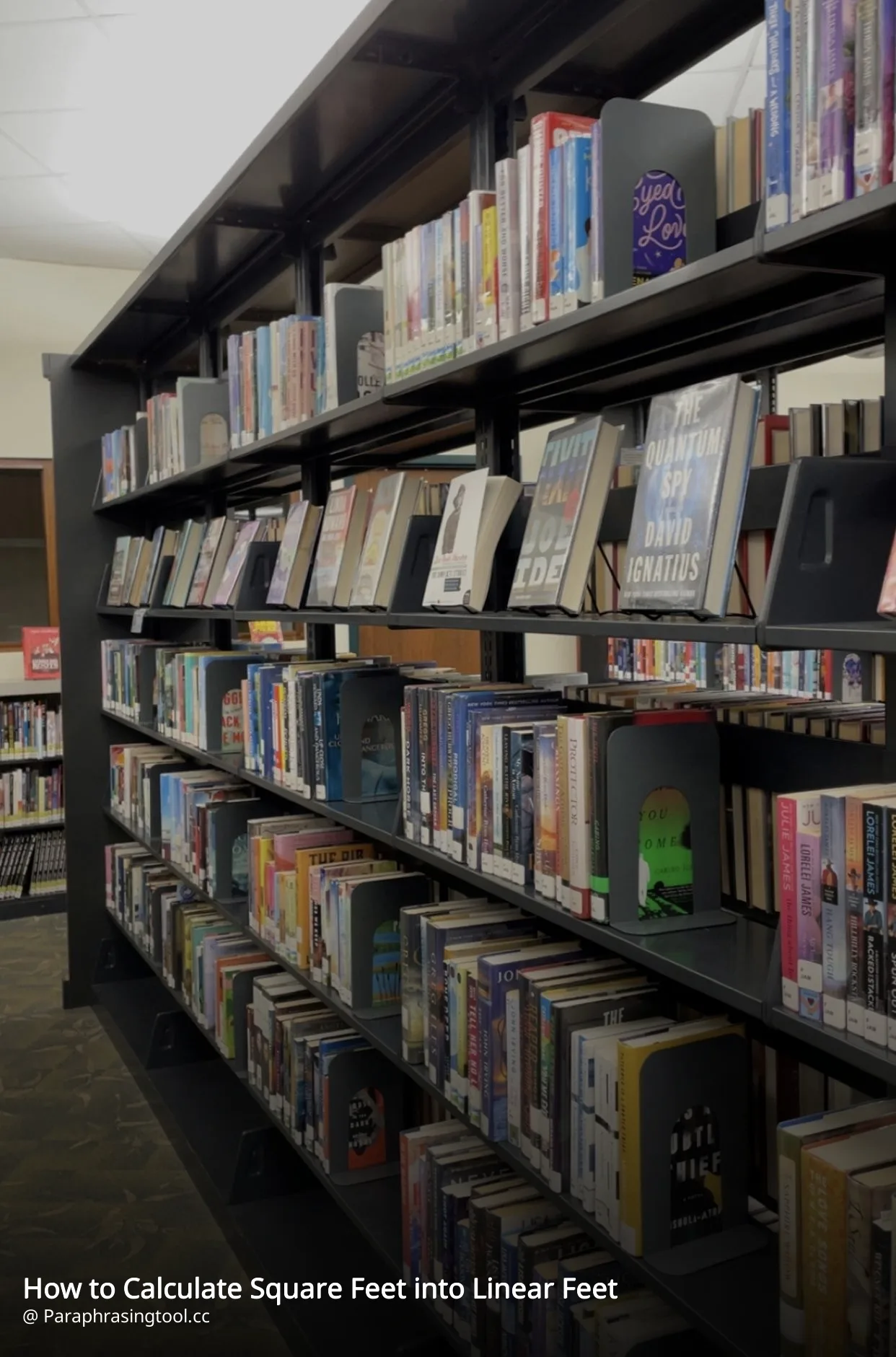
Linear feet (lin ft)represent one-dimensional length, like the perimeter of a room or the length of trim. Unlike square feet, linear feet do not account for width.
Direct conversion isn't possible without width because:
Area (sq ft) = Length (lin ft) × Width (ft)
Thus, Length (lin ft) = Area (sq ft) ÷ Width (ft)
Need to paraphrase text from this article?Try our free AI paraphrasing tool — 8 modes, no sign-up.
✨ Paraphrase NowStep-by-Step Guide to Convert Square Feet to Linear Feet
- Determine the total square footage.Measure or note the area in square feet.
- Identify the width.This is crucial—use the material's width (e.g., 6-inch plank = 0.5 ft) or space dimension (e.g., room width for coverage).
- Apply the formula:Linear feet = Square feet ÷ Width in feet.
- Calculate and round up if needed.Add 10% buffer for cuts and waste in practical scenarios.
Example Calculation
Suppose you have 500 sq ft of flooring to install, using planks that are 6 inches (0.5 ft) wide.
Linear feet = 500 sq ft ÷ 0.5 ft = 1,000 linear feet.
You'll need 1,000 lin ft of planks. If the room is irregularly shaped, measure sections separately and sum the results.
Another example: For baseboards around a 400 sq ft room. First, calculate the perimeter (assume 80 ft total linear wall length, ignoring doors/windows). Baseboards cover the wall length directly, so linear feet equals perimeter, not divided by area. Clarify context: use area-to-linear for coverage like carpet or siding, perimeter for edging.
Practical Applications
- Flooring and tiling:Divide room sq ft by tile/plank width to get linear footage needed.
- Siding and fencing:Convert wall sq ft to linear board feet using board width.
- Landscaping:Estimate linear feet of edging from garden bed area and edging height (as proxy width).
- Engineering and architecture:Scale drawings or material takeoffs for cost estimates.
In academic settings, this reinforces dimensional analysis: always match units (ft² / ft = ft).
Common Mistakes to Avoid
- Forgetting width:Results in meaningless numbers—always specify.
- Mixing units:Convert inches to feet first (12 inches = 1 ft).
- Ignoring waste:Add 5–15% extra for cuts, overlaps, or errors.
- Confusing with perimeter:Perimeter gives linear feet directly; use area only for coverage conversions.
Summary
To calculate square feet into linear feet, divide the area by the width in feet. This simple formula supports efficient material planning across construction and design. For quick results without manual math, use the free converter tool on HowToConvertUnits.com—enter your values for instant, accurate linear feet output.