 Paraphrasing
Citing multiple paraphrased sentences refers to the academic practice of attributing ideas rephrased in one's own words from a single source across several consecutive sentences. This technique maintains intellectual honesty while integrating source material smoothly into writing. Researchers and students often search for guidance onhow to cite multiple paraphrased sentencesto avoid plagiarism and adhere to style guides like APA, MLA, or Chicago. Proper citation ensures credibility, supports arguments with evidence, and respects original authors' contributions in essays, research papers, and reports.
What Does Citing Multiple Paraphrased Sentences Involve?
Citing multiple paraphrased sentences involves rephrasing ideas from a source in your own words over several sentences while providing clear attribution to the original author. Typically, this occurs when drawing extended ideas from one source without direct quotation. The key is to signal the source once or strategically within the passage, depending on the style guide, to indicate the origin of the information.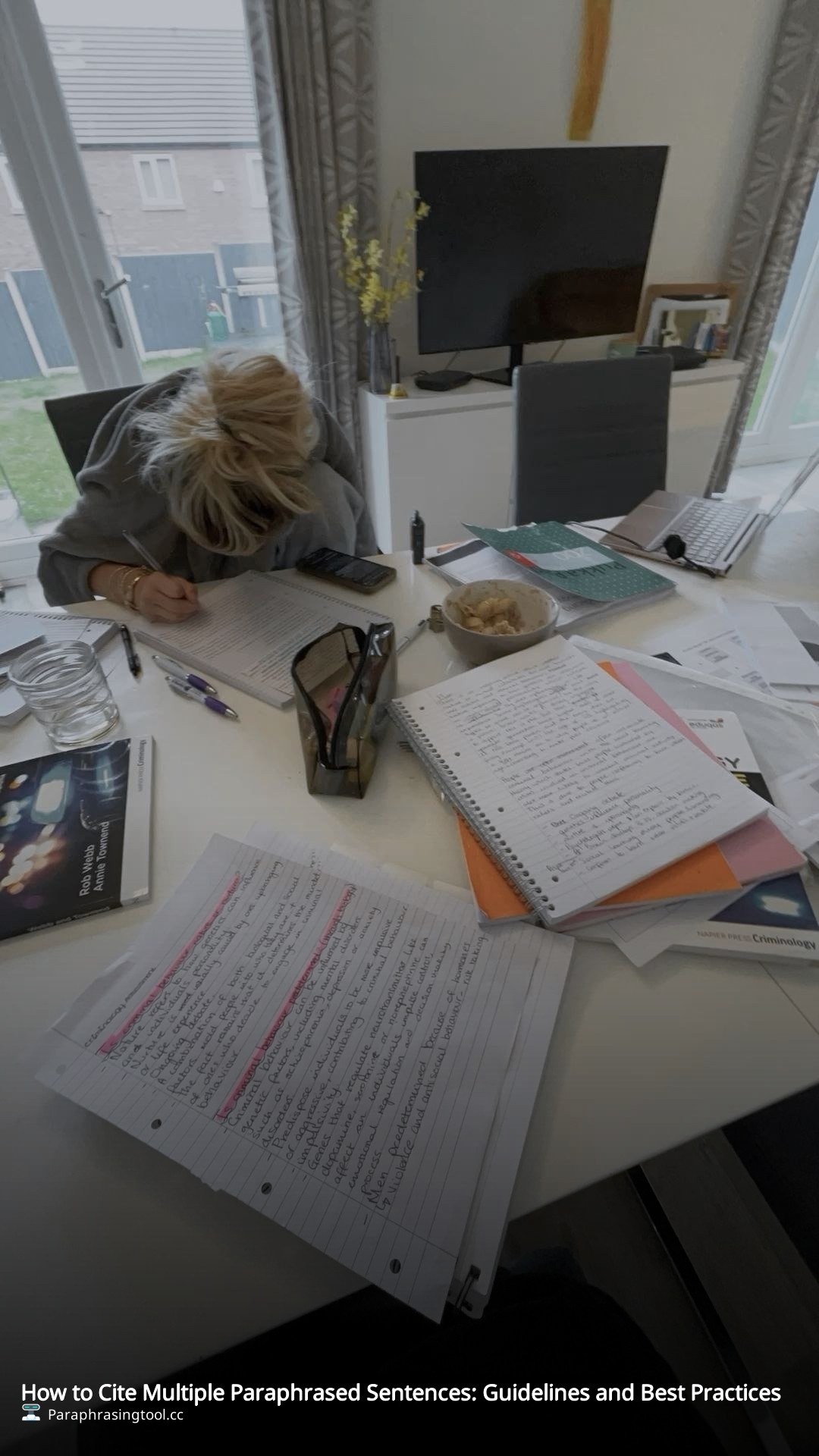
For instance, if a source discusses climate change impacts over three paragraphs, a writer might paraphrase key points into two or three sentences. Attribution prevents misrepresentation and allows readers to trace ideas back to their roots. This method differs from quoting, as it prioritizes synthesis over verbatim reproduction.
Why Is Citing Multiple Paraphrased Sentences Important?
Properly citing multiple paraphrased sentences upholds academic integrity by distinguishing original thoughts from borrowed ones, reducing plagiarism risks. It also enhances the paper's scholarly value, as readers can verify claims against primary sources. Institutions and publishers enforce these rules to foster ethical scholarship.
Failure to cite can lead to penalties, such as grade deductions or publication rejections. Moreover, accurate citation builds trust with audiences and demonstrates research depth. In fields like social sciences or humanities, where ideas evolve through reinterpretation, this practice supports ongoing discourse.
How Do You Cite Multiple Consecutive Paraphrased Sentences from One Source?
To cite multiple consecutive paraphrased sentences from one source, paraphrase the content fluidly and place a single citation at the end of the final sentence or paragraph. This approach signals that all preceding ideas derive from the same origin, streamlining the text without repetitive parentheticals.
Consider this example: A study on urban migration notes rising populations strain infrastructure (Smith, 2020). Economic factors drive this trend, exacerbating housing shortages. Local policies often lag behind these demographic shifts (Smith, 2020). Here, one citation at the end covers the block. If interrupting with original analysis, cite after each paraphrase cluster. Always check the specific style guide for nuances.
What Are the APA Rules for Citing Multiple Paraphrased Sentences?
In APA style (7th edition), cite multiple paraphrased sentences from the same source with a single parenthetical reference at the end of the passage, including the author and year. Use narrative citations (e.g., Smith (2020) argues...) for variety if mentioning the author in text.
Example: Urban growth challenges water supply management. Developers prioritize expansion over sustainability. These trends predict future shortages (Johnson, 2019). For sources with page numbers, include them optionally for precision (Johnson, 2019, p. 45). APA emphasizes conciseness, avoiding citations after every sentence unless clarity demands it. Subsequent citations in the same paragraph omit the year if unambiguous.
How Does MLA Handle Citing Multiple Paraphrased Sentences?
MLA style (9th edition) recommends citing multiple paraphrased sentences with one parenthetical reference at the paragraph's end, typically featuring the author's last name and page number. Integrate smoothly to maintain narrative flow.
For example: Migration patterns reveal economic disparities in cities. Workers seek opportunities amid uneven development (Doe 123). If no page numbers (e.g., websites), use chapter or paragraph identifiers. MLA prioritizes author-page format for literary and humanities work, differing from APA's year focus. Avoid over-citing; one reference suffices for continuous paraphrase from one source.
What About Chicago Style for Multiple Paraphrases?
Chicago style, via notes-bibliography or author-date systems, allows citing multiple paraphrased sentences with a single superscript note number at the passage end or one author-date reference. The notes-bibliography suits humanities, providing full details in footnotes.
Need to paraphrase text from this article?Try our free AI paraphrasing tool — 8 modes, no sign-up.
✨ Paraphrase NowExample (author-date): Climate models forecast intensified storms¹ (Lee 2021). Coastal areas face erosion risks. Adaptation strategies remain underdeveloped (Lee 2021). In footnotes: ¹Lee, *Climate Report* (New York: Pub., 2021), 67-70. Chicago offers flexibility, recommending judgment based on reader needs. Full bibliographic entries follow in the reference list.
Common Mistakes When Citing Multiple Paraphrased Sentences
A frequent error is omitting citations entirely, assuming paraphrasing eliminates the need for attribution. Even rephrased ideas require credit. Another pitfall: placing citations after every sentence, cluttering text unnecessarily.
Other issues include mixing sources without clear demarcation or ignoring style-specific rules, such as APA's year inclusion. Writers sometimes cite only the first sentence, misleading readers about idea origins. Tools like plagiarism checkers help, but manual review ensures accuracy. Always proofread for consistent formatting.
When Should You Use Block Quotes Instead of Paraphrasing?
Use block quotes for paraphrased sentences when the original wording carries unique authority, eloquence, or technical precision that paraphrasing might dilute. Block format applies to quotes of 40+ words in APA or 100+ in MLA, indented without quotation marks.
Paraphrasing suits synthesis; block quotes preserve voice for pivotal passages. For multiple sentences, decide based on analysis needs—paraphrase for brevity, quote for emphasis. Balance prevents over-reliance on sources, promoting original contribution.
Related Concepts to Understand
Patchwriting, blending source phrases without full paraphrase, risks plagiarism—fully reword instead. Signal phrases (e.g., according to, research shows) introduce citations effectively. Mosaic plagiarism arises from inadequate attribution in blended paraphrases, underscoring vigilant sourcing.
People Also Ask
Do I need to cite every paraphrased sentence?No, not individually if consecutive from one source. A single citation at the end covers the block in most styles, promoting readability.
Can I cite the source once for an entire paragraph?Yes, for continuous paraphrases from that source. Introduce variety with narrative citations if needed, but confirm style guide rules.
What if paraphrases are from different parts of the source?Include page or section numbers for each cluster to aid verification, especially in precise fields like law or sciences.
In summary, masteringhow to cite multiple paraphrased sentencesinvolves selecting the appropriate style guide method—typically one citation per block—and prioritizing clarity. This practice safeguards integrity while enriching writing. Review guidelines regularly, as editions evolve, and apply consistently across documents for professional results.