 Paraphrasing
In academic settings, students often encounter the question:is using a paraphraser bad in college? A paraphraser refers to software or online tools designed to reword existing text while attempting to preserve the original meaning. These tools have gained popularity with advancements in artificial intelligence, prompting debates about their role in education.
People search for this topic due to concerns over academic integrity, plagiarism detection, and institutional policies. Understanding the implications helps students navigate ethical use, balancing efficiency with genuine learning. This article examines the practice objectively, drawing from common academic standards and expert analyses.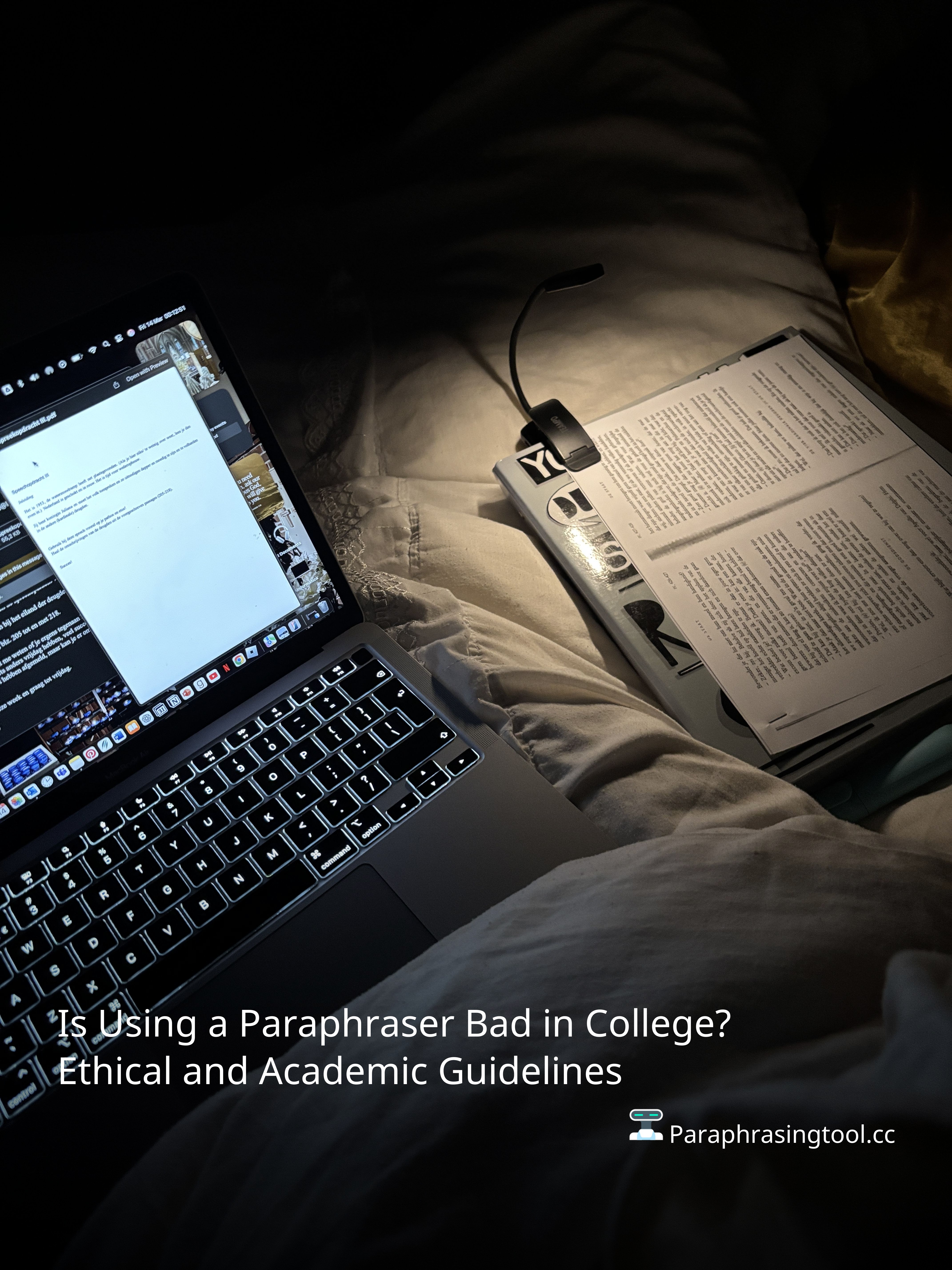
What Is a Paraphraser?
A paraphraser is a digital tool that automatically rewrites input text by substituting synonyms, altering sentence structures, and reorganizing phrases. Unlike direct copying, it aims to produce original-sounding output from source material.
These tools range from simple rule-based algorithms to advanced AI models trained on vast datasets. For example, inputting a sentence like "Climate change affects global weather patterns" might yield "Global weather patterns are impacted by climate change." Users in college often apply them to essays, research papers, or study notes to refine wording or avoid repetition.
While accessible via free websites or apps, paraphrasers vary in accuracy. Basic versions may introduce errors, such as changing nuanced meanings, whereas sophisticated ones mimic human writing more closely.
How Do Paraphrasing Tools Function in Academic Contexts?
Paraphrasing tools process text through natural language processing techniques. They analyze syntax, semantics, and context to generate alternatives, often using machine learning models like transformers.
In college workflows, a student might paste a quoted source into the tool, receive a rephrased version, and integrate it into an assignment. This process speeds up drafting but requires verification for fidelity to the original intent. Detection software, such as Turnitin, increasingly flags AI-generated paraphrases by identifying unnatural patterns or low perplexity scores.
Effectiveness depends on the tool's quality and user oversight. Poorly paraphrased content can distort facts, leading to factual inaccuracies in academic submissions.
Is Using a Paraphraser Bad in College?
Using a paraphraser is not inherently bad, but its acceptability hinges on intent, transparency, and institutional rules. If employed to bypass understanding source material or evade plagiarism checks without comprehension, it constitutes academic dishonesty.
Academic integrity policies at most colleges emphasize original thought and proper citation. Paraphrasing without crediting sources violates these, regardless of tool use. Surveys from educational bodies like the International Center for Academic Integrity indicate rising concerns, with over 60% of instructors viewing unacknowledged AI assistance as cheating.
Conversely, using it as an aid for non-native speakers to clarify phrasing—followed by manual revision and citation—aligns with ethical standards. The key is whether it enhances or replaces learning.
What Do College Policies Say About Paraphrasing Tools?
College policies on paraphrasing tools vary but increasingly address AI explicitly. Institutions like Harvard and Stanford prohibit undisclosed use of generative AI in assignments, classifying it under plagiarism or unauthorized aid.
Many syllabi now include clauses requiring disclosure of tool usage. For instance, professors may mandate "human-generated" work or allow tools only for brainstorming. Honor codes typically define misconduct as submitting work not primarily one's own.
Students should consult their institution's academic handbook or syllabus. Non-compliance risks penalties from grade deductions to expulsion, enforced via plagiarism detectors evolved to spot paraphrased AI content.
When Should Paraphrasing Tools Be Used in College?
Paraphrasing tools suit low-stakes scenarios like personal note-taking, brainstorming outlines, or polishing personal drafts after full comprehension. They prove useful for overcoming writer's block or expanding vocabulary in early drafts.
Avoid them for high-stakes graded work unless permitted. Best practices include: reading and understanding the source first, using the tool for suggestions only, manually rewriting, and citing originals. For group projects, disclose usage to collaborators.
Need to paraphrase text from this article?Try our free AI paraphrasing tool — 8 modes, no sign-up.
✨ Paraphrase NowIn research-heavy courses, tools can summarize dense readings for initial review, but final papers demand original synthesis.
Advantages and Limitations of Paraphrasers
Advantages include time efficiency, exposure to varied phrasing, and support for multilingual students. They help generate ideas quickly, potentially improving draft quality when combined with critical review.
Limitations are significant: outputs often lack depth, introduce biases from training data, or fail on technical subjects. Overreliance hinders skill development in critical thinking and writing, core college competencies. Detection risks persist, as tools like GPTZero identify AI paraphrasing with 80-90% accuracy in recent studies.
Ethical limitations arise from undermining fairness; not all students have equal access or awareness.
Common Misunderstandings About Using Paraphrasers
A frequent misconception is that paraphrased text is undetectable and thus safe. Modern plagiarism checkers incorporate AI forensics, tracing patterns back to generators.
Another error: assuming paraphrasing equals original work. True paraphrasing requires deep understanding and transformation, not mechanical rewording. Tools cannot replicate human insight or context-specific nuance.
Finally, some believe tools eliminate citation needs. All sourced ideas, even rephrased, demand attribution per styles like APA or MLA.
Alternatives to Paraphrasing Tools in College
Manual paraphrasing builds skills: read the source multiple times, note key ideas, close the text, and rewrite from memory. Thesaurus use or peer feedback offers controlled assistance.
Writing centers provide tutoring on rephrasing techniques. Citation tools like Zotero manage sources ethically. Active reading strategies, such as summarizing aloud, foster comprehension without tech dependency.
These methods promote long-term proficiency over short-term shortcuts.
In summary,is using a paraphraser bad in collegedepends on context—ethical when supplemental and disclosed, problematic when substitutive. Prioritize understanding, citation, and policy adherence to uphold academic standards. Students benefit most from tools that support, rather than supplant, learning processes.
People Also Ask
Can colleges detect paraphrasing tools?Yes, advanced detectors analyze linguistic markers like uniformity in sentence length or probabilistic patterns unique to AI, achieving high accuracy rates.
Is paraphrasing the same as plagiarism?No, proper paraphrasing with citation is legitimate; plagiarism occurs without attribution or when meaning is altered dishonestly.
What are the best practices for ethical paraphrasing?Understand the source, rewrite in your words, cite accurately, and verify for accuracy—tools optional but not primary.