 Paraphrasing
In academic and professional writing,how to do in text citations that i have paraphrasingrefers to the process of crediting sources within the body of a document when restating ideas in your own words. Paraphrasing involves rephrasing someone else's content while retaining the original meaning, and proper in-text citations ensure academic integrity. People search for this topic to avoid plagiarism, meet citation style requirements, and strengthen the credibility of their work. Understanding these citations is crucial for essays, research papers, and reports across disciplines like humanities, sciences, and social studies.
What Are In-Text Citations for Paraphrased Content?
In-text citations for paraphrased content are brief references embedded directly in the text to indicate the source of rephrased ideas. Unlike direct quotations, which use exact wording with quotation marks, paraphrases require citations to acknowledge the original author's intellectual contribution without copying verbatim.
These citations typically include the author's last name and publication year (in styles like APA) or a page number (in MLA). They direct readers to a full reference list at the document's end. For instance, if paraphrasing a study on climate change, an in-text citation links your summary to the source, preventing misrepresentation.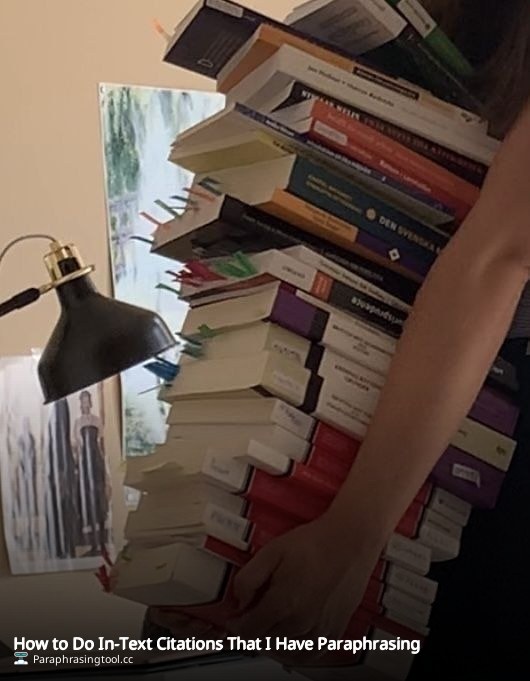
The core purpose is traceability: readers can locate the original source for verification. This practice upholds ethical standards in scholarly communication.
How Do In-Text Citations Work When Paraphrasing?
In-text citations for paraphrasing operate by placing a shortened source identifier immediately after the paraphrased idea, often in parentheses. The exact format varies by style guide, but the principle remains consistent: signal the source without interrupting the narrative flow.
Key steps include: (1) Identify the paraphrased idea's origin; (2) Note essential details like author, year, or page; (3) Insert the citation at the sentence's end or integrate it narratively; (4) Ensure the full source appears in the bibliography.
For example, in APA style: Original source states, "Climate models predict rising sea levels." Paraphrase: Rising sea levels are forecasted by climate models (Smith, 2020). This method balances readability with attribution.
Why Is Proper Citation of Paraphrased Material Important?
Proper citation of paraphrased material prevents plagiarism, a serious academic offense that can lead to penalties like failing grades or expulsion. It also demonstrates respect for intellectual property and enhances your writing's authority by building on established research.
Beyond ethics, citations allow readers to engage with primary sources, fostering deeper analysis. In professional contexts, they support evidence-based arguments, improving persuasiveness in reports or articles.
Neglecting citations risks undermining credibility, as unsupported claims appear unsubstantiated. Consistent use also trains writers in research skills essential for advanced studies.
What Are the Key Differences Between Citing Quotes and Paraphrases?
Citing direct quotes requires quotation marks around the exact text, plus a citation, emphasizing verbatim reproduction. Paraphrases, however, omit quotes since the wording is original, relying solely on the citation for attribution.
In APA, a quote might read: "Sea levels will rise" (Smith, 2020, p. 45). A paraphrase: Sea levels are expected to increase (Smith, 2020). MLA uses author-page for both but mandates quotes for direct text: (Smith 45) after quotes, similar for paraphrases.
Paraphrasing shows deeper comprehension, as it integrates ideas fluidly, whereas quotes preserve original phrasing for impact or uniqueness. Choose based on whether preserving exact language adds value.
When Should In-Text Citations for Paraphrasing Be Used?
Use in-text citations for paraphrasing whenever you draw from another source's ideas, data, theories, or findings—even if reworded. This applies to facts not considered common knowledge, such as specific statistics or unique arguments.
Common scenarios include literature reviews, argumentative essays, and empirical reports. No citation is needed for general knowledge (e.g., "Water boils at 100°C"), but specialized claims require it.
Always cite if the idea originated elsewhere, regardless of paraphrase extent. Multiple paraphrases from one source can share a single citation if grouped logically.
Need to convert units quickly?Try our free online unit converter — length, temperature, area, volume, weight and more, no sign-up needed.
📐 Convert Units NowHow to Do In-Text Citations for Paraphrasing in Major Styles
Different style guides dictate formats, so select based on your field's conventions or assignment guidelines. APA suits social sciences, MLA humanities, and Chicago history or publishing.
APA (7th Edition):Author-date system. Paraphrase example: Economic growth influences policy (Johnson, 2019). Multiple authors: (Johnson & Lee, 2019). No page for paraphrases unless quoting.
MLA (9th Edition):Author-page. Example: Economic growth shapes policy (Johnson 112). Integrates as: Johnson notes economic growth shapes policy (112).
Chicago (17th Edition, Author-Date):Similar to APA: (Johnson 2019, 112). Use footnotes for notes-bibliography variant, but author-date suits sciences.
Adapt for no author (use title) or multiple sources ((Johnson, 2019; Lee, 2021)). Software like reference managers can automate, but manual verification ensures accuracy.
Common Misunderstandings About In-Text Citations for Paraphrasing
A frequent error is assuming paraphrasing eliminates citation needs; rephrasing does not confer ownership of ideas. Another is inconsistent formatting across a document, confusing readers.
Writers sometimes over-cite common knowledge or under-cite synthesized ideas from multiple sources—combine as (Johnson, 2019; Lee, 2021). Page numbers are optional in APA for paraphrases but recommended in MLA for precision.
Clarify by reviewing style manuals: Paraphrase deeply to avoid "patchwriting," where original structure lingers, still requiring citation.
Related Concepts to Understand
Parenthetical citations (in parentheses) contrast with narrative citations (author named in sentence). Both work for paraphrases: Smith (2020) argues... or ...as shown (Smith, 2020).
Summarizing condenses broader content similarly to paraphrasing, needing citations. Block quotes handle long excerpts, but paraphrasing streamlines text.
Reference lists complement in-text citations: APA's is alphabetical, MLA's "Works Cited" matches exactly.
People Also Ask
Do I need a page number for paraphrased in-text citations?In APA, page numbers are optional for paraphrases but required for quotes. MLA recommends them for specificity, enhancing verifiability.
Can I paraphrase without citing if I change most words?No, citation is mandatory for any borrowed idea, regardless of wording changes, to credit the originator.
What if the source has no author for a paraphrase?Use a shortened title in quotes or italics: ("Climate Report" 2020) in APA, or ("Climate Report" 15) in MLA.
In summary, masteringhow to do in text citations that i have paraphrasinginvolves selecting the right style, integrating citations seamlessly, and applying them consistently to paraphrased content. This skill safeguards against plagiarism while bolstering argumentative strength. Practice with sample sources reinforces accuracy across formats like APA, MLA, and Chicago, ensuring ethical and professional writing standards.